
Daylength in South Africa: What Your Latitude Means for Photoperiod Cannabis

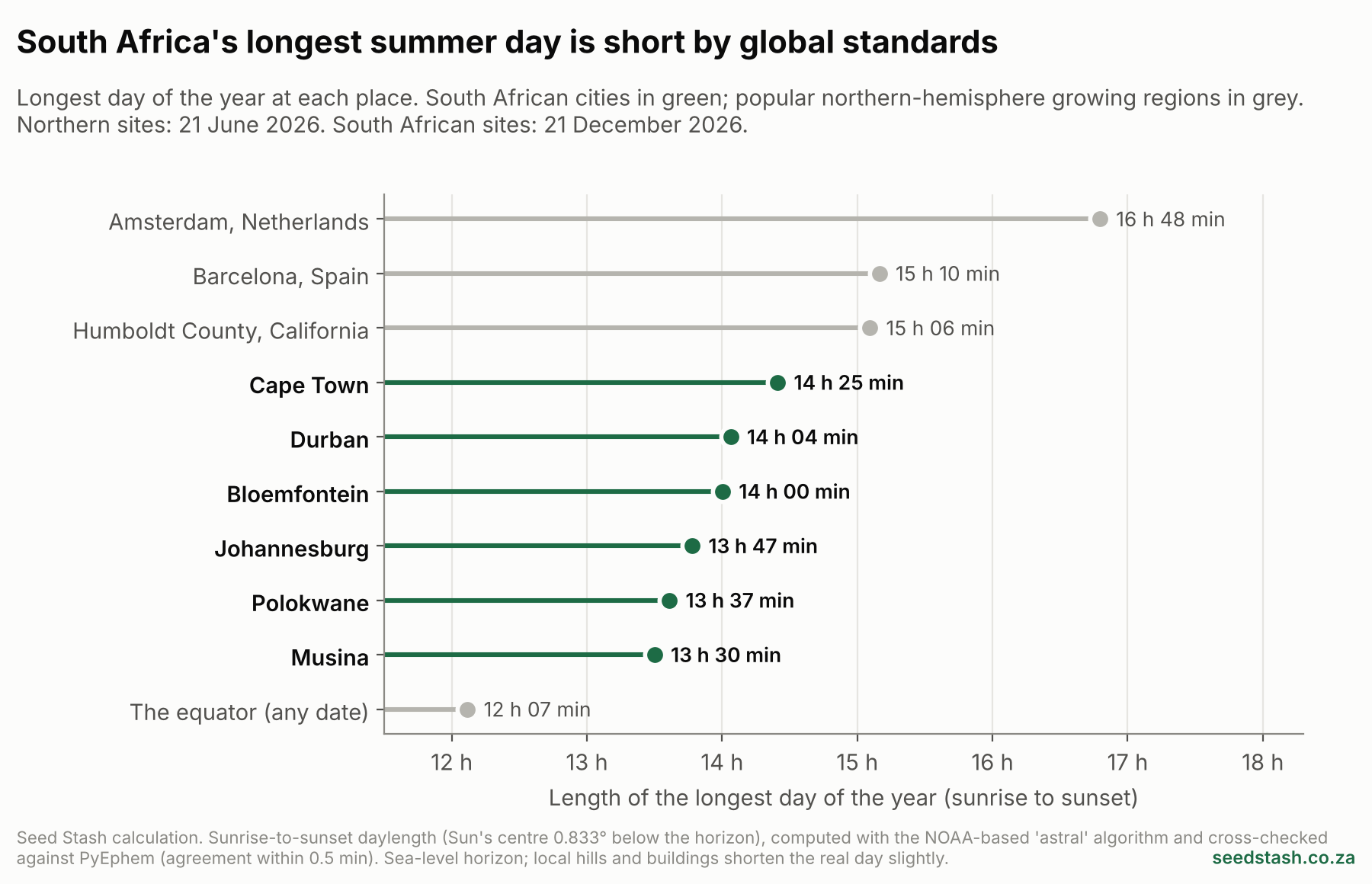
Photoperiod cannabis decides when to flower by reading the length of the day. Yet most grow calendars, strain descriptions and flowering advice were written for places such as the Netherlands, Spain or northern California, where midsummer days last 15 to 17 hours.
Daylength in South Africa is very different. Our longest day is 14 h 25 min in Cape Town and only 13 h 30 min in Musina. We calculated daylength for eight South African cities across a full season and set it against what controlled studies have found about cannabis flowering thresholds. The simple picture comes first. The detailed data on cultivar thresholds, twilight and indoor photoperiods follows further down for readers who want it.
Table of Contents
Daylength at a glance
The daylength figures are astronomy, calculated for each city. The flowering thresholds come from growth-room studies, mostly on hemp. No South African field trial of flowering time was found.
14 h 25 min
the longest day of the year in Cape Town. Musina’s is 13 h 30 min; Amsterdam’s is 16 h 48 min.
0 days
with 14 hours of daylight or more in Johannesburg, Pretoria, Polokwane or Musina. Cape Town gets 63.
21 Dec
is midsummer here, so northern-hemisphere grow calendars need shifting by six months.
1 · Our summers are shortEvery South African city’s longest day is shorter than in the regions where most grow guides are written. The further north you live, the shorter it gets.
Higher confidenceMain limitation: calculated for a flat sea-level horizon; hills and buildings shorten your real day.
Higher confidenceMain limitation: calculated for a flat sea-level horizon; hills and buildings shorten your real day.
2 · That can mean earlier floweringPhotoperiod plants flower once days drop below a genetic threshold. In growth rooms, many cultivars’ thresholds sat between about 13¾ and 15½ hours, at or above a Highveld summer day.1
Moderate (thresholds) · Limited (SA gardens)Main limitation: hemp cultivars in growth rooms; no South African field trials found.
Moderate (thresholds) · Limited (SA gardens)Main limitation: hemp cultivars in growth rooms; no South African field trials found.
3 · Autoflowers sidestep itAutoflowering plants flower by age, not daylength, largely because of a single recessive gene.2
Higher confidence (genetics)Main limitation: how autoflowers perform in South African conditions was not tested in these studies.
Higher confidence (genetics)Main limitation: how autoflowers perform in South African conditions was not tested in these studies.
Quick reference: your city’s key dates. When the sunrise-to-sunset day first drops below 13 and 12 hours after midsummer, 2026/27 season. The full table, with more cities and thresholds, is in section 2.
| City | Longest day | Days with 14 h or more | Drops below 13 h | Drops below 12 h |
|---|---|---|---|---|
| Cape Town | 14 h 25 min | 63 | 24 Feb | 24 Mar |
| Durban | 14 h 04 min | 26 | 20 Feb | 25 Mar |
| Bloemfontein | 14 h 00 min | 6 | 19 Feb | 25 Mar |
| Johannesburg | 13 h 47 min | 0 | 14 Feb | 25 Mar |
| Polokwane | 13 h 37 min | 0 | 10 Feb | 26 Mar |
| Musina | 13 h 30 min | 0 | 7 Feb | 26 Mar |
1. Daylength basics in one minute
Section summary
- Photoperiod cannabis flowers once the daily light period drops below a threshold set by its genetics, called the critical photoperiod.
- Very young plants pass through a juvenile phase in which they do not respond to daylength.
- South Africa’s longest day falls around 21 December and its shortest around 21 June, the reverse of Europe and North America.
Cannabis is a short-day plant. Photoperiod cultivars stay in vegetative growth while days are long and switch to flowering once the daily light period falls below a threshold. Researchers call that switch point the critical photoperiod, and it is not one number for all cannabis. In a Florida growth-room study of hemp cultivars, it ranged from under 14 hours to more than 15 hours depending on the cultivar.1
Two details matter for growers. First, very young plants pass through a juvenile phase in which they do not respond to daylength, and its length differs between genetics.1 Second, short days act quickly on a mature plant: under a 12-hour photoperiod, plants in the same study began flowering about 13 to 14 days after the switch.1
South Africa’s seasons are the mirror image of the northern hemisphere’s. Any grow calendar written for Europe or North America needs shifting by six months before it makes sense here. Daylength also depends on latitude, and that is where South Africa differs in a way a simple date shift cannot fix.
2. Daylength in South Africa, city by city
Section summary
- Every city crosses 12 hours on almost the same dates: around 18–20 September and 24–26 March.
- What changes with latitude is the summer peak: 14 h 25 min in Cape Town, 13 h 47 min in Johannesburg and 13 h 30 min in Musina.
- Only Cape Town, Gqeberha, Durban and, barely, Bloemfontein get any days of 14 hours or more.
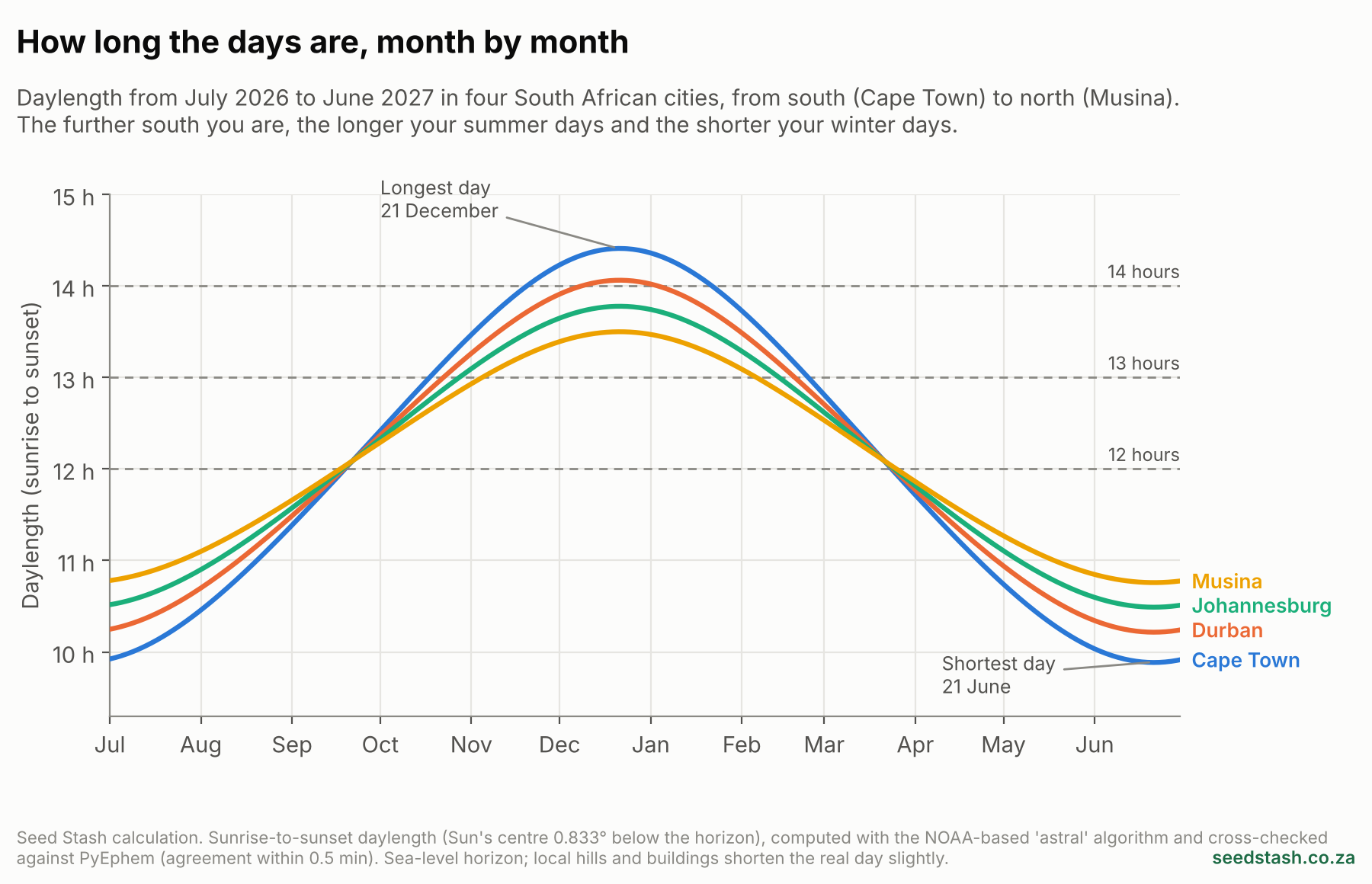
We calculated sunrise-to-sunset daylength for every day from July 2026 to June 2027 in eight cities, from Cape Town (34° S) to Musina (22° S). The curves in Figure 2 cross at the equinoxes, when day and night are close to equal everywhere, then fan out. In summer the southern cities pull ahead. In winter the order reverses and Musina keeps the longest days.
The size of the swing is the real difference. Cape Town’s daylength changes by about 4½ hours across the year, Musina’s by under 2¾ hours. Cape Town and Gqeberha have 63 days of 14 hours or more, from about 20 November to 21 January. Durban gets 26, Bloemfontein six, and Johannesburg, Pretoria, Polokwane and Musina none at all.
| City | Latitude | Longest day | Shortest day | Days ≥ 14 h | Below 13½ h | Below 13 h | Below 12½ h | Below 12 h |
|---|---|---|---|---|---|---|---|---|
| Cape Town | 33.9° S | 14 h 25 min | 9 h 53 min | 63 | 9 Feb | 24 Feb | 10 Mar | 24 Mar |
| Gqeberha | 34.0° S | 14 h 25 min | 9 h 53 min | 63 | 9 Feb | 24 Feb | 10 Mar | 24 Mar |
| Durban | 29.9° S | 14 h 04 min | 10 h 13 min | 26 | 1 Feb | 20 Feb | 8 Mar | 25 Mar |
| Bloemfontein | 29.1° S | 14 h 00 min | 10 h 16 min | 6 | 30 Jan | 19 Feb | 8 Mar | 25 Mar |
| Johannesburg | 26.2° S | 13 h 47 min | 10 h 29 min | 0 | 21 Jan | 14 Feb | 6 Mar | 25 Mar |
| Pretoria | 25.7° S | 13 h 45 min | 10 h 31 min | 0 | 20 Jan | 13 Feb | 6 Mar | 25 Mar |
| Polokwane | 23.9° S | 13 h 37 min | 10 h 39 min | 0 | 11 Jan | 10 Feb | 4 Mar | 26 Mar |
| Musina | 22.4° S | 13 h 30 min | 10 h 46 min | 0 | — | 7 Feb | 3 Mar | 26 Mar |
3. Why short summers matter for photoperiod plants
Section summary
- If a cultivar’s threshold is longer than your longest day, nothing in the season holds a mature plant in vegetative growth.
- That is more likely the further north you are. On the Highveld and in Limpopo, the sunrise-to-sunset day never reaches 14 hours.
- This is an inference from growth-room studies. We found no South African field trial that measured it.
Put the two pieces together. A photoperiod plant stays vegetative only while the day is longer than its critical photoperiod. In the growth-room study, many cultivars’ thresholds sat between about 13¾ and 15½ hours.1 In Cape Town, the summer day stays above 14 hours for two months, which can hold back a cultivar with a lower threshold. In Johannesburg the day peaks at 13 h 47 min and in Musina at 13 h 30 min. For a cultivar with a 15-hour threshold, every day of a Highveld or Limpopo summer is already a short day.
We would therefore expect photoperiod plants grown further north to start flowering earlier, and at a smaller size, than timelines written for higher latitudes suggest. That applies especially to plants set outside in early spring, when days are only 12 to 12½ hours long. This is a reasoned expectation, not a measured result: we found no controlled South African study of when photoperiod cannabis starts flowering at different latitudes. It is also one reason stated flowering windows vary so much, a topic we cover in how accurate breeders’ flowering times are.
A few practical steps follow from the physics rather than from trials. Check your own daylength on the day you plant out, so you know the signal your plants are getting. Plants kept under long artificial days until they reach the size you want can go outside later, when natural days take over. And genetics with lower thresholds, or autoflowers, may suit short-summer regions better. Each of these is worth testing in your own garden rather than taking on trust.
4. Autoflowers: opting out of daylength
Section summary
- Autoflowering is largely controlled by one recessive gene, Autoflower1, mapped to chromosome 1.
- A second locus, Early1, was linked with flowering 2–4 weeks earlier.
- Because autoflowers do not wait for short days, latitude matters far less for them.
Autoflowering, or day-neutral, cannabis flowers once it reaches a certain age, whatever the daylength. A 2022 Cornell University study mapped the main cause to a single recessive locus, Autoflower1, on chromosome 1. A plant needs two copies to autoflower.2 Plants carrying one copy still behaved as photoperiod plants but flowered about two weeks earlier in the field. The same team mapped a second locus, Early1, linked with flowering 2–4 weeks earlier.2
Day-neutral behaviour also turned up in the Florida study, where four grain and fibre hemp cultivars (CFX-1, Joey, Tygra and Helena) flowered even under 24 hours of light.1 Two caveats apply. The Autoflower1 markers did not predict every day-neutral line tested, so other genetic routes exist. And the popular story that autoflowering came from Cannabis ruderalis rests mostly on grey literature, so its origin remains unresolved.2
For South African growers the practical point is simple. The latitude effects in this article matter far less for autoflowers, although temperature, light intensity and season length still do.
Going deeper: the detailed data
The sections below are for readers who want the numbers behind the summary: cultivar thresholds, how fast the days change, twilight, and indoor photoperiod trials.
5. Flowering thresholds versus South African summers
Section summary
- In a Florida growth-room study, nine hemp cultivars had thresholds pinned down to between 13 h 45 min and 15 h 30 min.
- Six of the nine had thresholds above even Cape Town’s longest day.
- Cultivars sold under the same name by different seed sources did not always behave alike, so names are a weak guide.
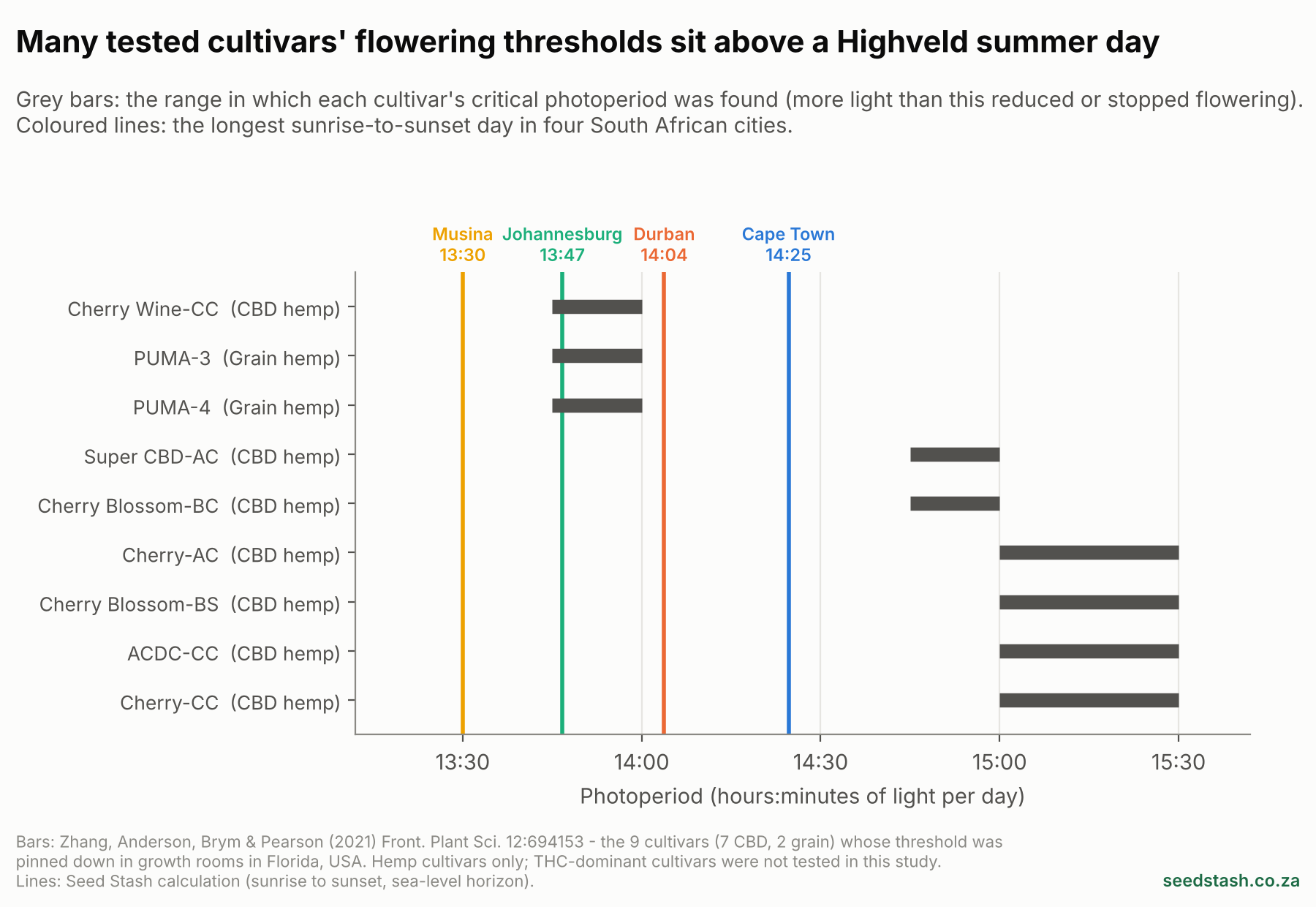
Figure 3 sets the clearest threshold data we found against South Africa’s summer peaks. Zhang and colleagues exposed essential-oil (CBD), grain and fibre hemp cultivars to photoperiods from 12 to 24 hours in growth rooms at 25 °C. Individual plants were the experimental unit, with 4 to 10 plants per treatment.1 The team pinned the critical photoperiod down for nine cultivars. Three (Cherry Wine-CC, PUMA-3 and PUMA-4) switched between 13 h 45 min and 14 h, two between 14 h 45 min and 15 h, and four between 15 h and 15 h 30 min.1
Above the threshold, flowering often slowed rather than stopping outright. Essential-oil cultivars were delayed by 7 to 8 days once photoperiods exceeded 14 hours, and none flowered at 18 hours.1 The seed source mattered too: ‘Cherry Blossom’ from one source switched between 14 h 45 min and 15 h, and from another between 15 h and 15 h 30 min.1
These are hemp cultivars. For THC-dominant cultivars, published threshold data are thinner. A 2023 Australian paper cites industry data putting five genotypes’ critical photoperiods between 13 h 18 min and 13 h 55 min.4 A 2024 Canadian paper cites earlier work in which about half of ten indoor cultivars showed minimal flowering delay up to 13½ hours.3 We could not check those underlying datasets directly. If they are representative, a Highveld summer day of 13 h 47 min sits right in the band where some cultivars are held back slightly and others are not.
Moderate confidence: hemp thresholds between about 13¾ and 15½ hours (one controlled study; cultivar- and source-dependent). Limited: thresholds for THC-dominant cultivars, which rest on figures cited second-hand.
6. How fast the days shrink
Section summary
- Days change fastest around the equinoxes and barely at all near midsummer.
- Cape Town loses up to 2.1 minutes of daylight a day in March; Musina at most 1.3.
- The 13½-hour mark arrives about a month earlier in Polokwane than in Cape Town.

Daylength changes slowly near the solstices and fastest near the equinoxes. Around 21 December, every South African city gains or loses only seconds a day. By mid-February, Cape Town is losing about 2 minutes a day and Musina about 1.2.
Because the northern cities start from a lower peak, they cross each threshold sooner. Polokwane’s day falls below 13½ hours by 11 January, Johannesburg’s by 21 January and Durban’s by 1 February; Cape Town’s not until 9 February. Musina only just touches 13½ hours on midsummer day. The studies we reviewed used fixed photoperiods, so they do not tell us whether plants also respond to how quickly the day is changing.
7. Twilight and stray light at night
Section summary
- Civil twilight adds about 46–60 minutes of dim light to the sunrise-to-sunset day, depending on city and season.
- One study measured twilight at about 2.4 µmol·m⁻²·s⁻¹ and raised the possibility that plants count it. That was not tested.
- A 2024 conference abstract reported flowering delays in sensitive cultivars from night light as weak as 0.01 µmol·m⁻²·s⁻¹.
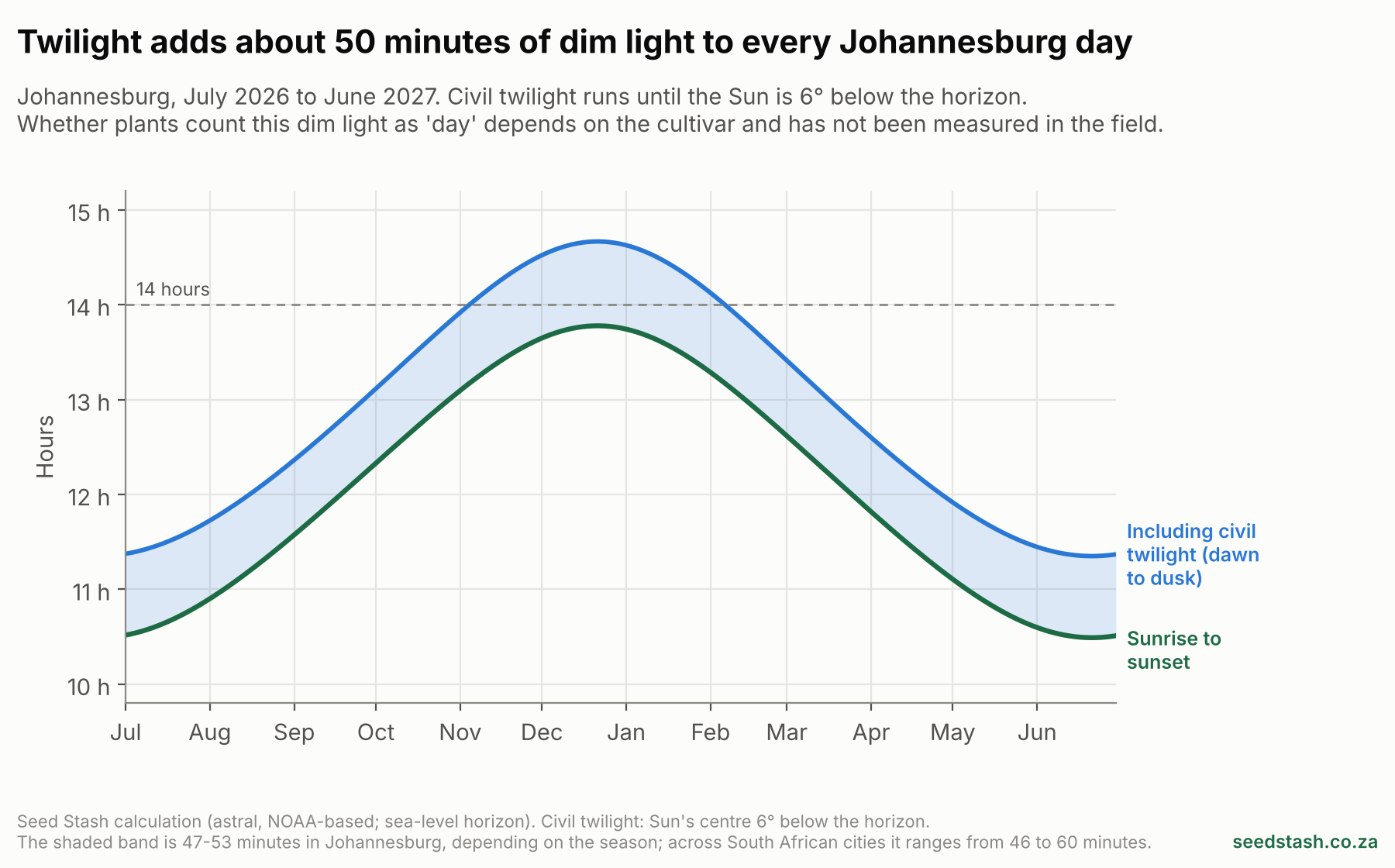
Sunrise and sunset are convenient markers, but the sky is not dark at either. Civil twilight lasts until the Sun is 6° below the horizon. Counting it adds 47 to 53 minutes to Johannesburg’s day and up to an hour in Cape Town. That would lift Johannesburg’s midsummer day from 13 h 47 min to about 14 h 40 min (Figure 5).
Does a plant count that light? Zhang and colleagues measured light at civil twilight at about 2.4 µmol·m⁻²·s⁻¹ and raised the possibility that twilight adds to the day a plant perceives, without testing it.1 A 2024 presentation at the American Society for Horticultural Science conference reported that continuous white LED light at night as weak as 10 nmol·m⁻²·s⁻¹ (0.01 µmol·m⁻²·s⁻¹) delayed flowering in the most sensitive of ten cannabis cultivars. Red light at 5 nmol did the same.5 That is a conference abstract, not a peer-reviewed paper. If it holds up, though, twilight is hundreds of times brighter than the levels that affected sensitive plants.
The same abstract carries a practical message. Stray light from security lights, street lights or a neighbour’s window may matter for sensitive cultivars, and even cultivars whose flowering was not delayed showed effects on height and flower development.5 The table below shows how far the calendar would move if twilight counted in full.
| City | Longest dawn-to-dusk day | Drops below 14 h | Drops below 13½ h | Shift vs sunrise-to-sunset (13½ h) |
|---|---|---|---|---|
| Cape Town | 15 h 24 min | 21 Feb | 6 Mar | +25 days |
| Durban | 15 h 00 min | 14 Feb | 2 Mar | +29 days |
| Johannesburg | 14 h 40 min | 7 Feb | 26 Feb | +36 days |
| Polokwane | 14 h 29 min | 1 Feb | 23 Feb | +43 days |
| Musina | 14 h 21 min | 27 Jan | 21 Feb | — |
Limited confidence: whether twilight or low-level night light changes flowering outdoors. The evidence is one untested hypothesis and one conference abstract.
8. Indoors: is 12/12 really the rule?
Section summary
- Two recent studies challenge 12 hours as the fixed flowering photoperiod.
- 13 hours instead of 12 raised flower dry weight by 35% and 50% in two THC-dominant cultivars.
- 14 hours raised flower mass in three cultivars but cut THC concentration in two of them.
Indoors you choose the daylength, and the 12/12 convention is being tested. At the University of Guelph, two THC-dominant cultivars (‘Incredible Milk’ and ‘Gorilla Glue’) were flowered under 13 hours of light instead of 12. Flower dry weight rose by 35% and 50%, far more than the 8% increase in total daily light. Flowering started about 1.5 days later in one cultivar and on time in the other, although signs of maturity such as pistil browning came later in both.3 The authors warn that their small plots may overstate gains at commercial planting densities.3
In Australia, Peterswald and colleagues compared 10, 12 and 14 hours in three cultivars.4 Every plant flowered, and 14 hours gave more flower mass in all three. But plants held at 14 hours saw THC concentration fall from 12% to 7% in ‘Northern Lights’ and from 10% to 6% in ‘Hindu Kush’. The CBD cultivar ‘Cannatonic’, by contrast, roughly doubled its CBD yield.4
Both studies used fixed, abrupt photoperiods, so they do not transfer directly to a garden where the day shortens gradually. They do show that 13 or 14 hours is not automatically too long for every cultivar, which fits the threshold data above. For the light-intensity side of the indoor picture, see our evidence review on light intensity, yield and potency.
Moderate confidence: some cultivars flower well, and yield more, under 13–14 hours indoors. Five cultivars across two studies, small plots, and THC fell at 14 hours in two of three.
9. How confident can we be?
Section summary
- The daylength numbers are solid; how plants respond to them in South African gardens is the open question.
- The biggest gap is a multi-site South African field trial of photoperiod cultivars.
| Claim | Confidence | Why |
|---|---|---|
| Daylength figures for each city | Higher | Astronomical calculation; two independent methods agree within half a minute |
| Hemp thresholds of about 13¾–15½ h | Moderate | One controlled study; varies by cultivar and seed source |
| Thresholds for THC-dominant cultivars | Limited | Figures cited second-hand; underlying data not public |
| Earlier flowering further north in SA | Limited | Inference from growth-room data; no SA field trial found |
| Twilight and night light delay flowering | Limited | Hypothesis plus one conference abstract |
| Longer indoor photoperiods raise yield | Moderate | Two studies, five cultivars, small plots; THC fell at 14 h in two |
The study that would settle this is simple to describe: the same set of photoperiod and autoflowering cultivars planted on the same dates in, say, Cape Town, Durban, Johannesburg and Polokwane, with flowering start, yield and chemistry recorded. Measuring twilight and night-light levels at each site would answer the twilight question at the same time.
Conclusion
South Africa sits closer to the equator than the regions where most cannabis grow advice is written, and the numbers show it. Our longest day runs from 14 h 25 min in Cape Town down to 13 h 30 min in Musina, and four of the eight cities we checked never reach 14 hours of sunrise-to-sunset daylight.
Growth-room studies suggest many photoperiod cultivars switch to flowering somewhere between about 13¾ and 15½ hours. For many genetics, then, a South African summer, especially an inland or northern one, is already a short day. The astronomy is certain; how plants respond in local gardens has not yet been measured. Know your daylength, choose genetics with it in mind, and treat imported timelines as a starting point rather than a promise.
References
- Zhang M, Anderson SL, Brym ZT, Pearson BJ (2021). Photoperiodic flowering response of essential oil, grain, and fiber hemp (Cannabis sativa L.) cultivars. Frontiers in Plant Science 12:694153. doi.org/10.3389/fpls.2021.694153
- Toth JA, Stack GM, Carlson CH, Smart LB (2022). Identification and mapping of major-effect flowering time loci Autoflower1 and Early1 in Cannabis sativa L. Frontiers in Plant Science 13:991680. doi.org/10.3389/fpls.2022.991680
- Ahrens A, Llewellyn D, Zheng Y (2024). Longer photoperiod substantially increases indoor-grown cannabis’ yield and quality: a study of two high-THC cultivars grown under 12 h vs. 13 h days. Plants 13(3):433. doi.org/10.3390/plants13030433
- Peterswald TJ, Mieog JC, Azman Halimi R, Magner NJ, Trebilco A, Kretzschmar T, Purdy SJ (2023). Moving away from 12:12; the effect of different photoperiods on biomass yield and cannabinoids in medicinal cannabis. Plants 12(5):1061. doi.org/10.3390/plants12051061
- Eckels M (presenter) (2024). Night light pollution delays flowering in soybean and cannabis. Oral presentation abstract, American Society for Horticultural Science Annual Conference, session CE 4. Not peer reviewed. ashs2024.sched.com
- NOAA Global Monitoring Laboratory. Solar Calculation Details: the sunrise and sunset equations (after Meeus, Astronomical Algorithms) used for all daylength figures in this article. gml.noaa.gov/grad/solcalc/calcdetails.html
Methods and editorial notes
How this review was done. This is a targeted editorial review, not a systematic review. We searched scholarly and publisher sources in October 2026 for controlled studies of cannabis photoperiod, flowering thresholds, autoflowering genetics and night light. We read the full text of references 1–4; reference 5 is a conference abstract only.
Daylength calculation. Daily sunrise-to-sunset daylength for 1 July 2026 to 30 June 2027 was calculated with the NOAA solar equations6 (as implemented in the astral 3.2 Python library), with the Sun’s centre 0.833° below a flat sea-level horizon to allow for refraction and the solar disc. Civil twilight uses 6°. We cross-checked 16 city-and-date pairs against PyEphem; results agreed within half a minute. NOAA describes the method as accurate to within about a minute at these latitudes, and real weather can shift observed sunrise and sunset slightly. Coordinates are city centres. We did not adjust for altitude or local terrain; hills, buildings and trees usually shorten the effective day.
Figure 3. Threshold ranges are those stated by Zhang et al. for the nine cultivars whose critical photoperiod was identified.1 A range means flowering was high at the shorter photoperiod and reduced at the longer one. Cultivars reported only as “greater than” a value are not plotted.
Interests. Seed Stash sells cannabis seeds. This article does not recommend any strain or product.