
A Practical Deep Dive Into Training Cannabis Plants

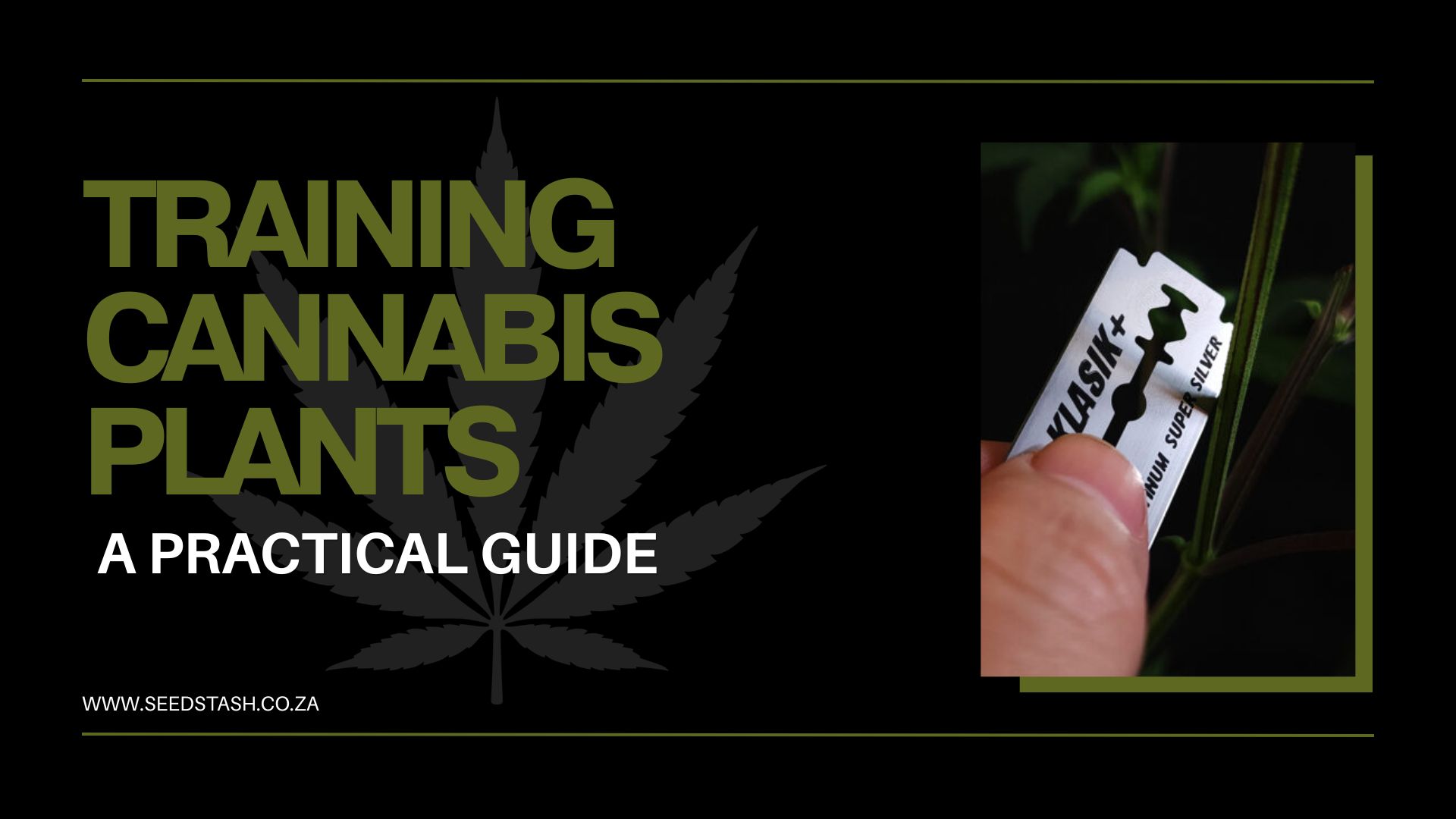
Training your plants can provide a few positive benefits, but it’s not as straight forward as the internet would like to make you think. Most grow sites cater to new growers who want surface level information, but the truth is that the training you use should serve a greater purpose. And training for one specific benefit may make it weaker in other areas.
Here’s what I wish I knew about plant training when I first started growing.
Training Is Only Really Important When Flowering Out Seed Plants
The truth is a lot of us breeders and pheno hunters don’t really train our plants anymore. That’s because flowering out seed plants only give one an idea of how the genotype expresses. A more accurate representation is when the plant is run from cut. So often, we’ll take clones off the seed plant and flower those out rather than just flowering out the seed plant. And so many experienced growers end up reducing a lot of the training methods we started using.
Decide What You Want to Achieve Before Training
Different training methods have different purposes. Most of the popular ones revolve around increasing yield and flower quality, but there are other reasons to train plants too.
When growing equatorial landrace varieties indoors, for example, there is often significant training used to prevent the plant from reaching the lights. This isn’t uncommon with some of the 16 week+ flowering plants, where uncontrolled vertical growth can quickly become a bigger problem than the plant’s ability to produce flowers.
Training can also be used to create a more even canopy, improve light distribution, reduce mold risks, control plant height, make better use of limited space, increase structural support, or remove parts of the plant that are unlikely to contribute meaningfully to the final harvest.
So before you start cutting indiscriminately, figure out what benefits your training is going to bring, and whether that aligns with your intended goals.
This is more important than it sounds because there is no perfect plant shape. A dense Afghani type for example, requires a lot different training than a landrace narrow-leaf drug type with 18 weeks flowering time and a meter between each branch node. Similarly, a plant with eight evenly spaced colas might be exactly what you want under a small indoor light, but a terrible structure for an outdoor plant that needs to support several hundred grams of flower. Likewise, a very open plant may improve light penetration, while excessive removal of leaves and branches can simply reduce the plant’s ability to intercept light in the first place.
Research into cannabis plant architecture backs up some of this. Manipulating branching and canopy structure can change how light reaches different parts of the plant, and this can affect both flower production and the consistency of cannabinoid concentrations throughout the plant. But the results aren’t universal, and the response depends on the plant, growing environment and the particular manipulation being used.
In other words, training should solve a problem rather than create a certain shape because someone on the internet told you that shape produces more yield.
Low-Stress vs. High-Stress Training
The distinction between low and high stress training methods is often exaggerated to account for new growers, but stress is a spectrum and even high stress techniques don’t need to slow down your plant growth much, depending on their stage of growth and overall health.
Low-stress training generally involves manipulating living stems without removing significant amounts of tissue. Bending, tying and spreading branches are the obvious examples. The main advantage is that you can change the architecture while retaining most of the plant’s leaves and growing points.
High-stress training involves more significant physical disruption, such as topping, pruning or deliberately damaging stems.
But I don’t think “stress” is the most useful way to think about it.
The more important question is what physiological change are you trying to cause?
When you remove the apical growing tip, for example, you aren’t simply stressing the plant and hoping it produces more flowers. You’re removing a dominant growing point and changing the hormonal and carbohydrate relationships that influence the growth of the lateral buds below it. Cannabis has strong apical dominance, and removing the main shoot can therefore encourage previously suppressed axillary shoots to develop.
Likewise, bending a branch down doesn’t magically create more energy for the plant. It changes the spatial arrangement of the canopy, potentially allowing previously shaded growth to receive more light and reducing the dominance of a single vertical shoot.
This distinction matters because training doesn’t create additional resources. It changes where the plant puts them and, perhaps more importantly, which parts of the plant get access to the resources already available.
There is also a cost to almost every form of training. Removing healthy leaves removes photosynthetic surface. Removing branches removes potential flower sites. Breaking or heavily bending stems requires the plant to repair tissue. And repeatedly topping a plant can consume considerable vegetative time that could otherwise have been spent building biomass.
This is why “more training” isn’t necessarily better training.
Common Training Methods & What They Actually Achieve
LST is probably the simplest form of plant training and, when done properly, one of the least disruptive.
Rather than removing the main growing tip, you bend the stem or branches and secure them in a different position. This can flatten an otherwise Christmas-tree-shaped plant into a wider canopy and allow more lateral branches to develop into useful positions.
The biggest advantage of LST is that you’re generally changing where the plant grows rather than removing what it has already grown.
This makes it particularly useful when you want to control height while retaining as much leaf area and branch structure as possible.
It also gives you considerably more control than a single topping event. Branches can be moved again as the plant grows, allowing you to respond to the actual structure of the plant rather than committing to a shape weeks in advance.
The downside is that LST doesn’t necessarily make a plant produce more biomass. If your light, root system and environment can only support a certain amount of growth, bending the plant won’t change that fundamental limitation.
What it can do is make better use of the space and light you already have.
Best used for:
Controlling height, spreading branches, improving canopy uniformity and making better use of a fixed light footprint.
Timing:
Usually during vegetative growth, although branches can be repositioned later provided they remain flexible enough.
Main consideration:
Don’t bend for the sake of bending. The goal should be a useful canopy, not a plant that looks like it has been tied into a pretzel.
Topping involves removing the shoot apical meristem, usually by cutting through the main stem above a suitable node.
This breaks the dominance of the central shoot and allows lateral branches to become much more prominent. The result is usually a plant with several stronger terminal branches rather than one dominant central stem.
This is one of the few training techniques where there is a clear physiological reason behind the result. Apical dominance in plants involves a complex interaction between auxin, cytokinin, sugars and other signals. Removing the shoot apex changes this relationship and can release axillary buds from their previous suppression. The old explanation that “auxin simply travels down from the top and stops the lower branches growing” is useful as a basic model, but the actual biology is considerably more complicated.
Topping is particularly useful when you want several primary branches to occupy similar positions in the canopy.
But there is an important misconception here:
Topping does not create extra energy.
A topped plant can produce a larger or more useful harvest under the right circumstances because its architecture may allow the available light to be distributed more effectively. But if you repeatedly top a plant and end up with dozens of growing tips competing for the same amount of light, you’ve simply divided the plant into more pieces.
This is why the old “one top gives two colas, two tops gives four, four gives eight…” explanation is technically describing the branching structure, but shouldn’t be interpreted as a guarantee of exponentially increasing yield.
Best used for:
Breaking apical dominance, controlling vertical growth and creating multiple primary branches.
Timing:
Generally while the plant is actively growing and has enough time to recover and establish the new branches before flowering.
Main consideration:
Don’t top because you’re trying to collect a certain number of colas. Top because you want the resulting architecture.
FIMing is similar to topping, but instead of completely removing the shoot tip, only part of the developing tip is removed.
The idea is to encourage several new growing points while retaining more of the original structure.
In practice, the result is considerably less predictable than topping. You can end up with several shoots, a malformed growing tip, or something that looks suspiciously like you simply missed when topping.
There is nothing wrong with using it, but I wouldn’t treat FIMing as some superior version of topping. Its value is mainly in situations where you want to manipulate the growing tip without making as complete a removal.
Best used for:
Creating branching while retaining more of the original shoot structure.
Timing:
Vegetative growth.
Main consideration:
Expect variation. Genetics and the exact location of the cut matter.
Mainlining is essentially a more deliberate form of repeated topping and branch manipulation designed to create a symmetrical plant structure.
The classic approach is to top the plant and then repeatedly train the resulting branches until a relatively symmetrical manifold is produced.
The attraction is obvious. If you have a restricted growing footprint, creating a predictable number of similarly positioned branches can make the canopy considerably easier to manage.
But mainlining is also a good example of why training should have a purpose.
You can spend weeks creating a perfectly symmetrical manifold only to discover that the plant would have produced more useful biomass if you’d simply allowed it to branch naturally and used LST to spread the resulting structure.
Mainlining isn’t inherently a higher-yielding method. It is primarily an architecture-management technique.
Recent literature examining mainlining specifically notes that the scientific evidence around the technique itself is still limited, despite the popularity of the method among growers.
Best used for:
Highly controlled plant architecture, restricted footprints and situations where predictable branch positioning is more important than maximum vegetative efficiency.
Timing:
Primarily vegetative growth, with enough time allowed for the plant to recover and establish the new structure.
Main consideration:
The more elaborate the manifold, the more worthwhile it becomes to ask whether the plant actually needs one.
Supercropping is one of the more aggressive forms of stem manipulation. The stem is deliberately pinched and bent, damaging the internal tissues while leaving the outer stem structure sufficiently intact to continue carrying the branch.
The resulting wound is repaired by the plant, and the branch can become more structurally robust as the damaged area heals.
This can be useful for controlling height and positioning branches, but the idea that supercropping automatically “makes the stems stronger and therefore produces more” is too simplistic.
You’re deliberately damaging the plant. Whether that damage is worthwhile depends on what you gain from the resulting architecture.
Supercropping can be particularly useful when a branch is becoming too tall or when you need to bring a dominant shoot back into an otherwise level canopy.
Best used for:
Height control, branch positioning and structural management.
Timing:
Usually while stems are still sufficiently flexible to manipulate without simply snapping.
Main consideration:
A damaged branch is still damaged tissue. Don’t assume every injury is beneficial simply because the plant can repair it.
Defoliation is where cannabis training advice tends to become particularly dogmatic.
Some growers remove large numbers of leaves because they believe that doing so allows the remaining leaves and flowers to receive more light. Others avoid removing healthy leaves almost completely.
The reality is more nuanced.
Leaves are the plant’s photosynthetic machinery. Removing them has an obvious cost, and there is no universal rule that removing healthy leaves increases yield.
However, leaves can also create significant shading within a dense canopy. In large cannabis plants, studies have found that lower inflorescences can receive dramatically less light than upper flowers, and that architectural manipulation can improve light penetration and cannabinoid uniformity in these shaded areas.
More recent research has also found that the response to defoliation varies between cultivars, with one study finding that defoliation reduced floral biomass in the tested cultivars while increasing cannabinoid concentrations in one of them.
That’s probably a better representation of reality than either “defoliation increases yield” or “never remove a leaf.”
Best used for:
Managing excessive canopy density and improving light penetration where shading is genuinely limiting useful growth.
Timing:
Most useful when there is enough canopy to justify removal. Avoid treating defoliation as an automatic event on a particular flowering day.
Main consideration:
Don’t remove a healthy leaf simply because it is blocking a bud. Ask whether that leaf is contributing more to the plant than the bud underneath it is likely to gain from being exposed.
Lollipopping involves removing lower branches and growth that is unlikely to develop into worthwhile flowers.
This can be particularly useful in dense indoor canopies where the lower portions of the plant receive very little light.
Again, however, the goal shouldn’t be to create a visually impressive bare stem.
Studies on cannabis architecture have found that low-light conditions deeper in the canopy can produce substantial differences in cannabinoid concentration between upper and lower inflorescences. Removing lower branches can therefore be a sensible way of directing the plant’s resources toward the parts of the canopy that are actually receiving useful light.
But there is a point of diminishing returns.
If the lower branches are receiving enough light to produce worthwhile flowers, removing them simply because they’re low on the plant may be counterproductive.
Best used for:
Removing poorly positioned lower growth, improving canopy airflow and concentrating productive growth within the useful light footprint.
Timing:
Usually during late vegetative growth or the early flowering transition, depending on the plant and growing system.
Main consideration:
Judge the branch by its position and access to light, not simply its height from the floor.
A screen of green, or ScrOG, is less a pruning technique than a method of using the plant’s natural growth to build a horizontal canopy.
Branches are trained through or under a screen so that multiple growing tips occupy roughly the same vertical plane.
The major advantage is light management. Instead of allowing one main stem to dominate vertically, the grower spreads the plant across the available footprint.
ScrOG can work exceptionally well in situations where there is a fixed light source and limited vertical space.
But it also requires commitment. Once a plant is heavily woven through a screen, moving individual branches becomes increasingly difficult.
Best used for:
Maximising a fixed indoor footprint, controlling height and creating a relatively uniform canopy.
Timing:
Training begins during vegetative growth and generally continues into the early stages of flowering as the plant stretches.
Main consideration:
Don’t fill the screen simply because you can. Leave enough space for the expected stretch and make sure the final canopy suits the light you actually have.
The Biggest Mistake With Training
The biggest mistake I see with training is treating every plant as though it should respond the same way. They don’t.
Cannabis genetics have a substantial influence on plant architecture, branching, flowering behaviour and biomass production. Recent genetic work has identified numerous genomic regions associated with traits including flowering time, plant architecture and biomass accumulation, which is another way of saying that the plant you’re working with matters enormously.
Two plants grown under the same light can respond very differently to the same training technique.
One may naturally produce long, flexible branches that are perfect for LST. Another may have short internodes and naturally form an excellent canopy without much intervention. One may recover almost immediately from topping, while another spends a significant amount of time rebuilding its structure.
This is why experienced growers often appear to do less.
They aren’t necessarily less interested in training. They’re better at identifying when training will actually solve a problem.
If a plant already has excellent structure, there may be little reason to repeatedly top it.
If the plant is naturally producing a huge amount of lower growth that will never receive useful light, removing some of it makes sense.
If an equatorial cultivar is going to outgrow your indoor space, training it early makes considerably more sense than waiting until flowering and trying to wrestle a two-metre plant back under control.
And if a plant is struggling, training it harder is almost never the solution.
Training Is About Trade-Offs
Every training decision comes with a trade-off.
Topping gives you more control over branching, but removes the existing apex and takes time to recover. LST retains more of the plant, but requires continued management.
Defoliation can improve light penetration, but removes photosynthetic tissue. Lollipopping can concentrate growth into the productive canopy, but removes potential flower sites.
Mainlining creates a highly predictable structure, but takes considerably more time and intervention than simply allowing a plant to branch naturally.
Even the idea of increasing yield needs to be treated carefully. A better-shaped plant can make better use of a given light footprint, but training doesn’t allow a plant to magically exceed the limitations imposed by light, roots, temperature, CO₂, nutrition and genetics.
Some research actually demonstrates this trade-off quite nicely. Increasing plant density can increase yield per unit area while reducing yield per individual plant, and the effects of architecture manipulation can differ depending on the density and growing environment.
That’s why there isn’t a single “best” training technique.
The best technique is the one that produces the plant structure you actually need.
Conclusion
Plant training is one of those subjects where experience eventually teaches you to do less, rather than more.
When I started growing I was obsessed with training, buying all the little clips and the training wires. That’s because every grow guide online talked about the importance of training, but very rarely pushing for the reader to understand when and when not they are appriopriate.
Spend more time thinking about what’s good for your plant and what it craves, and less about having to train for the sake of training.
One thought on “A Practical Deep Dive Into Training Cannabis Plants”